

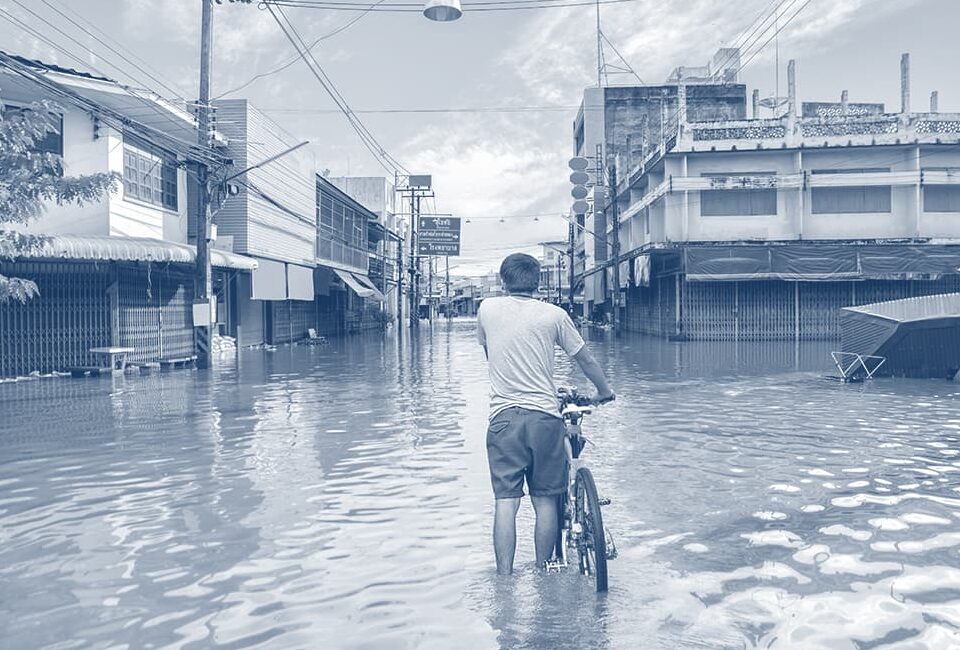
Perspectives on new study in Nature Climate Change by Avantika G., Ning L., Dazhi X., and K. Emanuel in Feb 2022: “Tropical cyclone climatology change greatly exacerbates US extreme rainfall–surge hazard” (ANDE-22)
Background
Storm surge or “storm tide” is one of the three key climate hazards posed by Atlantic hurricanes, the other two being wind and inland flood. Storm surge is primarily driven by intense winds passing over the ocean surface for extended distances and periods of time which results in water levels rising well above normal tide levels. When storm surge impacts the coastline it can cause severe coastal flooding and erosion. Storm surge damage can be exacerbated by wave action which in severe storms can significantly escalate coastal inundation. Storm surge is most often associated with tropical cyclones (e.g., hurricanes), but is also associated with extra-tropical cyclones or “ETCs” (e.g., winter storms, Nor’easters). Salt water damage due to surge can be particularly destructive to certain assets such as automobiles and electronics.
Inland flooding is another hurricane hazard driven by heavy precipitation. Rain-induced flooding in hurricanes is most often associated with overflow of a nearby river (called fluvial flooding); however heavy rainfall in urban areas can also cause pluvial (or “urban”) flooding due to capacity-limited and aging drainage systems stressed by growing populations. The concurrence of pluvial and fluvial flooding can compound damage. As with storm surge, fresh water from inland floods can cause severe water damage to buildings and their contents and is more conducive to mold intrusion compared to salt water from surge.
Objective
The objective of the recent article (ANDE-22) was to study the influence of climate change on the joint hazard of storm surge and inland flooding caused by Atlantic hurricanes.
Key Findings
- Expect significant increases in joint surge-rainfall hazard for U.S. East and Gulf coasts driven by climate-induced changes in future hurricane climatology combined with future sea-level rise (SLR). In most cases, the dominant driver of the increased joint hazard is heavier rainfall.
- The 100-year rainfall hazard is expected to double by end of the century (year 2100) while rainfall rates within 100km of a hurricane’s core are expected to increase by 32%, slightly higher than in previous studies. These results are based on the IPCC SSP5-8.5 high-emissions scenario.
- For 96% of the U.S. coastline at risk, the projected increase in joint rainfall-surge hazard is higher than the effect of SLR alone.
- While this study finds climatology changes dominate over SLR in the increased joint hazard, SLR will likely play a more important role in ETCs and shorter return period events.
- ANDE-22 applies a conservative SLR projection, which given the uncertainty may in turn underestimate its contribution to increases in the joint hazard.
- This study projects future increases in hurricane frequency for 5 of 8 Global Climate Model (GCM) projections used in the analysis, though most independent studies have predicted a frequency decrease. However, key findings of this study are unchanged assuming no frequency change.
- The authors explain their results are insensitive to frequency assumptions because joint hazard changes are largely dependent on increases in hurricane intensity and decreases in their translation speed, both of which contribute to higher rainfall accumulations.
- Expected changes in the joint rainfall-surge hazard are consistently higher in the Northeast US as compared to the Southeast and Gulf regions. This pattern is also unchanged when the increased frequency assumption is lifted.
Implications for Aeolus
This is an important study with credible findings directly applicable to Aeolus’ decision-making around hurricane risk. The study points out the important relationship between increased precipitation rates and rising sea-levels, both of which contribute to the local flood hazard of a landfalling hurricane. However, while the study merits consideration in our modeling, it is important to note the main driver of insured property damage in hurricanes across the damage footprint is wind and that in the U.S. most flood risk is managed by the National Flood Insurance Program (NFIP) and not private insurers. In addition, the study focuses on the IPCC 8.5 scenario (often deemed unrealistic) and projects risk out to the year 2100, whereas Aeolus manages risk in the current climate.
DISCLAIMER
THE INFORMATION CONTAINED IN THIS PAPER (THE “INFORMATION”) IS BEING FURNISHED TO RECIPIENTS ON A CONFIDENTIAL BASIS BY AEOLUS CAPITAL MANAGEMENT LTD. (“AEOLUS”) FOR DISCUSSION PURPOSES ONLY AND MAY NOT BE USED FOR ANY OTHER PURPOSE. THIS INFORMATION MAY NOT BE COPIED, RECORDED OR REPRODUCED OR OTHERWISE PROVIDED TO THIRD PARTIES IN WHOLE OR IN PART WITHOUT AEOLUS’ PRIOR WRITTEN CONSENT.
THIS PAPER CONTAINS INFORMATION REGARDING AEOLUS AND ITS AFFILIATES’ VIEWS ON VARIOUS UNCERTAIN SCIENTIFIC CONCEPTS AND CONTENT. RECIPIENTS AND THEIR ADVISORS SHOULD PERFORM THEIR OWN INDEPENDENT REVIEW WITH RESPECT TO SUCH MATTERS AND REACH THEIR OWN INDEPENDENT CONCLUSIONS.
WHILE EFFORT AND CARE HAS BEEN TAKEN IN PREPARING THE CONTENT OF THIS PAPER, AEOLUS AND THE AUTHORS DISCLAIM ALL WARRANTIES, EXPRESSED OR IMPLIED, AS TO THE ACCURACY OF THE INFORMATION SET OUT HEREIN. FURTHER, NEITHER AEOLUS NOR THE AUTHORS SHALL BE LIABLE FOR ANY LOSSES OR DAMAGES ARISING FROM THE USE OF, OR RELIANCE ON THE INFORMATION OR THE REFERENCES SET OUT HEREIN.
PORTIONS OF THE INFORMATION HAVE BEEN OBTAINED FROM THIRD PARTY SOURCES. WHILE SUCH INFORMATION IS BELIEVED TO BE RELIABLE BY AEOLUS AND THE AUTHORS, NO EXPRESS OR IMPLIED WARRANTY, REPRESENTATION OR GUARANTEE IS MADE AS TO THE CORRECTNESS, COMPLETENESS OR SUFFICIENCY OF SUCH THIRD PARTY INFORMATION. WHERE A THIRD PARTY RESOURCE HAS BEEN REFERENCED, AEOLUS SEEKS TO ACCURATELY CITE SUCH RESOURCE. NO CONTENT WITHIN THIS PAPER IS KNOWINGLY AN INFRINGEMENT OF COPYRIGHT. ANY POTENTIAL INFRINGEMENT CAN BE IMMEDIATELY ADDRESSED AND WHERE APPROPRIATE RECTIFIED, ON NOTIFICATION TO AEOLUS.
THIS PAPER CONTAINS THE CURRENT OPINIONS OF AEOLUS AND SUCH OPINIONS ARE SUBJECT TO CHANGE WITHOUT NOTICE. AEOLUS TAKES NO RESPONSIBILITY FOR UPDATING THE INFORMATION CONTAINED HEREIN AS FACTS OR AEOLUS’ VIEWS DEVELOP IN FUTURE. STATEMENTS IN THIS PAPER ARE MADE AS OF THE DATE OF THE INITIAL COMMUNICATION AND THERE SHALL BE NO IMPLICATION THAT THE INFORMATION IS CORRECT AS OF ANY TIME SUBSEQUENT TO SUCH DATE.
THE INFORMATION CONTAINED IN THIS PAPER IS NON-PUBLIC, CONFIDENTIAL AND PROPRIETARY IN NATURE. BY YOUR ACCEPTANCE OF THIS PAPER, YOU AGREE TO TREAT THE CONTENTS AS CONFIDENTIAL AND NOT TO USE IT IN ANY WAY DIRECTLY OR INDIRECTLY DETRIMENTAL TO AEOLUS.