

Perspectives on the science of “atmospheric river” episodes and their relationship to an active winter storm season
Applicability ■■■■■
Action Required ■
Background
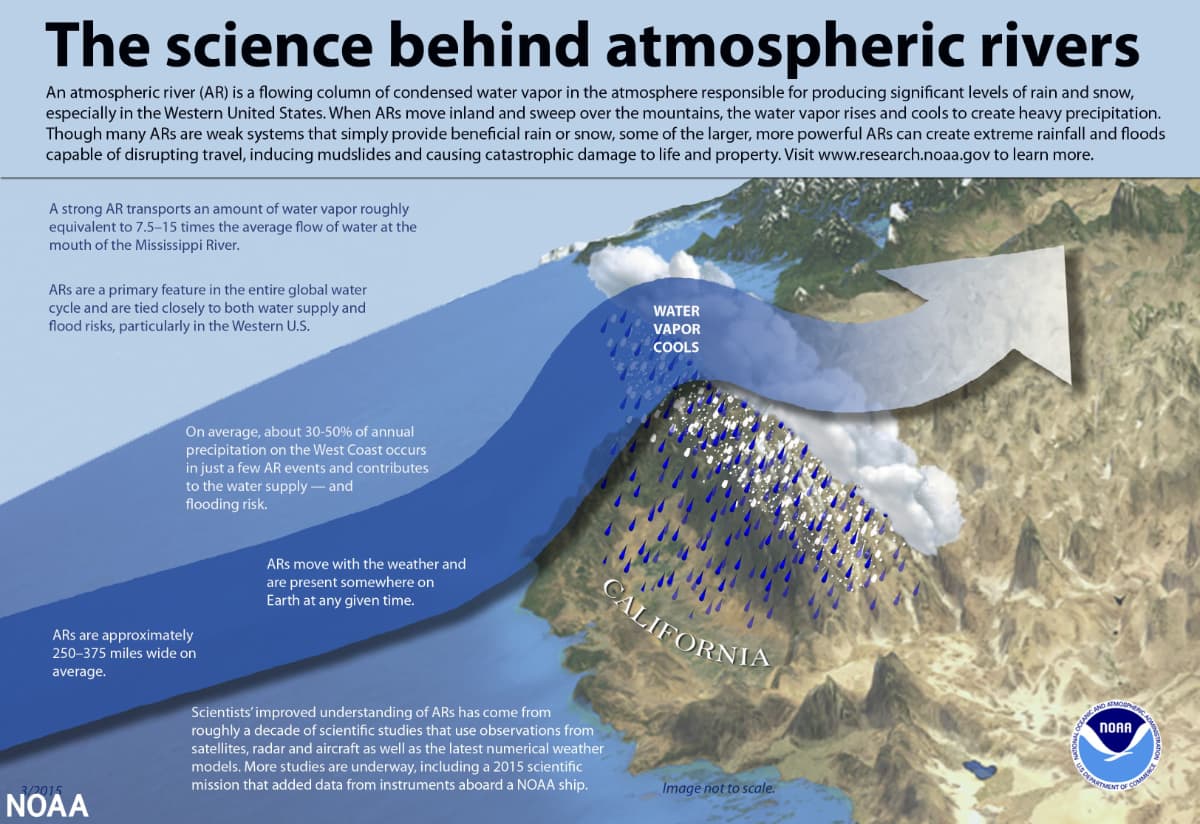
Atmospheric rivers (“ARs”) are relatively long bands of the atmosphere aloft that span several hundred miles wide. ARs transport water vapor from the tropics to the mid-latitudes. These dynamic columns of vapor move with upper-level winds and carry with them a vigorous combination of water in vapor and condensed (water) form equivalent to multiples of the average flow at the mouth of the Mississippi River. When ARs “make landfall”, they typically release moisture in the form of heavy rain, and where the air is sufficiently cold, heavy snowfall.
The term “atmospheric river” was originally coined in the early 1990s by researchers Reginald Newell and Yong Zhu at the Massachusetts Institute of Technology (“MIT”) to reflect the narrowness of the focused moisture plumes associated with the phenomenon. The graphic below provides a schematic view of a landfalling AR event. Note, the US West coast is particularly susceptible to AR moisture flows due to the substantial elevation rise occurring along the immediate coastline. Along much of the California coast, including the highly exposed Los Angeles and San Francisco metroplexes, the coastal ranges provide immediate uplift to an incoming AR band of moisture in vapor form, which in turn causes rising motion, then condensation of water vapor to rain droplets, eventually leading to more clouds and heavier precipitation.
ARs affecting California are not unusual. In fact, the National Oceanic and Atmospheric Administration (“NOAA”) points out that up to half of the US West Coast’s annual precipitation has its source in just a few AR events. Hence, ARs are part of Western US climatology and they routinely make a significant contribution to California’s annual water supply. Owing to the spurious nature of such events, they can be helpful in drought years and critical to maintaining water resources. On the other hand, a string of intense AR events can overwhelm water management infrastructure and lead to flooding and significant damage and loss of life.
Although ARs come in many shapes and sizes, those containing voluminous water vapor combined with strongest winds can lead to extreme rain accumulations and subsequent flooding. To exacerbate the problem, some ARs stall over highly exposed urban watersheds, vulnerable to inland riverine and flash flooding. These heavy rain events can induce mudslides and rockslides and can cause catastrophic loss of life and property.
A well-known example, known as the “Pineapple Express” is capable of bringing moisture from the Pacific tropical ocean waters near Hawaii to the US West Coast. AR events tend to be more active in the winter season when upper-level winds, known as the ‘jet stream’, are most intense since they are fueled by the contrast between temperatures at the poles and the equator.
AR events can also contribute to beneficial increases in snowpack. Unlike rainfall, excessive snowpack rarely translates to major damage, but provides ‘water storage’ for California’s dry season. For instance, a series of AR events in 2010 fueled a string of strong winter storms that battered the entire US West Coast from December 10th to 22nd, producing 20+ inches of rain in certain areas. These AR events lead to a snowpack in the Sierras corresponding to 75% of its normal annual total.
Location and seasonality
The figure to the right (Dettinger 2018) shows the relative frequency of 5-Year and 20-Year return period AR events by latitude and month. Note that the more extreme AR episodes occur between 35º and 45º latitude which roughly corresponds to the span of the central to northern California coast to the Pacific Northwest. ARs are most common between the months of October and January.
The ‘hot spot’ for season and location is centered along the northern California coastline in December, which closely corresponds to the activity witnessed in 2022-23. This tells us that the events of this winter season, whilst quite active, are in line with expectations for where and when we would expect these episodes to have their greatest impact.
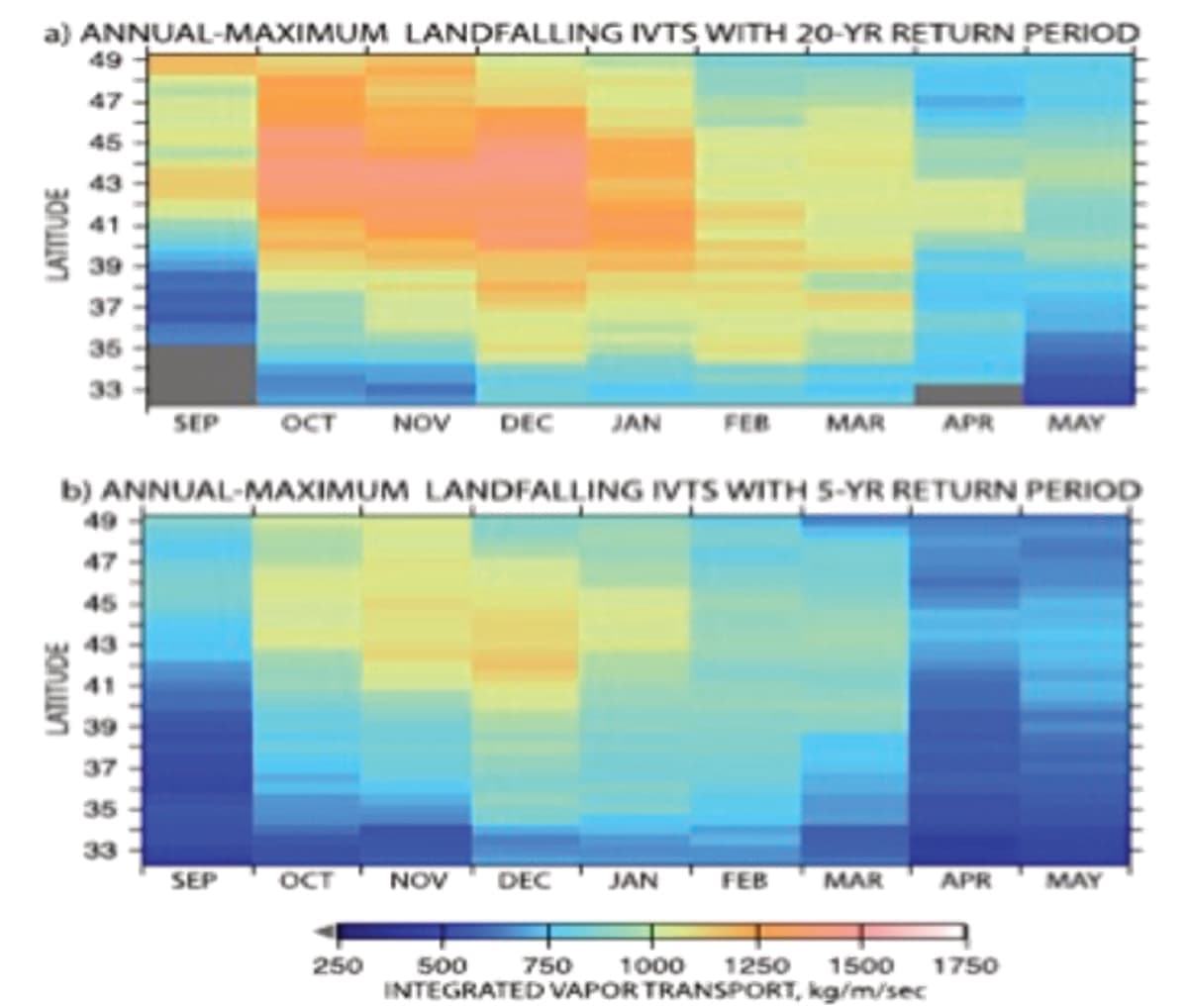
Source: Dettinger, M.D., Empirical Return Periods of the Most Intense Vapor Transports during Historical Atmospheric River Landfalls on the US West Coast. Journal of Hydrometeorology, July 2018.
Key Findings
- ARs are a feature of natural climate variability and a fundamental part of the US West coast’s annual precipitation cycle.
- Given the recent activity witnessed in 2022/23, a catastrophic AR episode that occurred in 1861-62 has recently received a great deal of attention in the press. That event is considered a 150+ return period event and was much more extreme than what has been observed recently. Still, its important to consider the potential impacts of these extreme ARs and their damage potential, which is more critical to agriculture and infrastructure than to insured property.
- Some parallels have also been drawn between recent activity and a series of heavy rain storms in January 1997 that caused $275M in property damage across the Western US (according to Property Claims Services). It is important to note, that, since then, the quality and scope of flood defenses has improved; further informed by the ARkStorm 2.0 project which has highlighted infrastructure vulnerabilities leading to further defense improvements.
- Given flood insurance take-up rates are low in California, insured losses for the AR events of 2022-23 are expected to be relatively low since the vast majority of both residential (about 1-3% take-up) and commercial (up to 30% take-up) properties are not insured.
- As the atmosphere warms, physics dictates that the air will hold more moisture, which increases the potential for more and stronger AR events. In turn, we expect an increase in precipitation extremes over parts of the US, making flood risk assessment an important component of the full risk profile. Modern flood models are able to assess the risk of extreme events, their frequency and severity, and for both pluvial and fluvial sources of risk.
Implications for Aeolus
As this article lays out, AR episodes are a natural part of the global climate cycle. Historically, the moisture that most ARs provide has been an important and beneficial component of water resource management for the Western US. Even in cases when they are more intense and persistent, AR events have not typically been major insurance events. That said, some aspects of AR risk, such as their damaging winds, are explicitly included in the major catastrophe models, while AR flood potential is included implicitly as a part of the modeled loss calibration process. Therefore, Aeolus Research continues to track the developing science around AR risk, in particular as it relates to the evolving science around climate change. The recent AR episodes in California will provide more data and ground truth to advance our scientific understanding and, as with all key perils, Aeolus is careful to leverage historical experience when setting price.
DISCLAIMER
THE INFORMATION CONTAINED IN THIS PAPER (THE “INFORMATION”) IS BEING FURNISHED TO RECIPIENTS ON A CONFIDENTIAL BASIS BY AEOLUS CAPITAL MANAGEMENT LTD. (“AEOLUS”) FOR DISCUSSION PURPOSES ONLY AND MAY NOT BE USED FOR ANY OTHER PURPOSE. THIS INFORMATION MAY NOT BE COPIED, RECORDED OR REPRODUCED OR OTHERWISE PROVIDED TO THIRD PARTIES IN WHOLE OR IN PART WITHOUT AEOLUS’ PRIOR WRITTEN CONSENT.
THIS PAPER CONTAINS INFORMATION REGARDING AEOLUS AND ITS AFFILIATES’ VIEWS ON VARIOUS UNCERTAIN SCIENTIFIC CONCEPTS AND CONTENT. RECIPIENTS AND THEIR ADVISORS SHOULD PERFORM THEIR OWN INDEPENDENT REVIEW WITH RESPECT TO SUCH MATTERS AND REACH THEIR OWN INDEPENDENT CONCLUSIONS.
WHILE EFFORT AND CARE HAS BEEN TAKEN IN PREPARING THE CONTENT OF THIS PAPER, AEOLUS AND THE AUTHORS DISCLAIM ALL WARRANTIES, EXPRESSED OR IMPLIED, AS TO THE ACCURACY OF THE INFORMATION SET OUT HEREIN. FURTHER, NEITHER AEOLUS NOR THE AUTHORS SHALL BE LIABLE FOR ANY LOSSES OR DAMAGES ARISING FROM THE USE OF, OR RELIANCE ON THE INFORMATION OR THE REFERENCES SET OUT HEREIN.
PORTIONS OF THE INFORMATION HAVE BEEN OBTAINED FROM THIRD PARTY SOURCES. WHILE SUCH INFORMATION IS BELIEVED TO BE RELIABLE BY AEOLUS AND THE AUTHORS, NO EXPRESS OR IMPLIED WARRANTY, REPRESENTATION OR GUARANTEE IS MADE AS TO THE CORRECTNESS, COMPLETENESS OR SUFFICIENCY OF SUCH THIRD PARTY INFORMATION. WHERE A THIRD PARTY RESOURCE HAS BEEN REFERENCED, AEOLUS SEEKS TO ACCURATELY CITE SUCH RESOURCE. NO CONTENT WITHIN THIS PAPER IS KNOWINGLY AN INFRINGEMENT OF COPYRIGHT. ANY POTENTIAL INFRINGEMENT CAN BE IMMEDIATELY ADDRESSED AND WHERE APPROPRIATE RECTIFIED, ON NOTIFICATION TO AEOLUS.
THIS PAPER CONTAINS THE CURRENT OPINIONS OF AEOLUS AND SUCH OPINIONS ARE SUBJECT TO CHANGE WITHOUT NOTICE. AEOLUS TAKES NO RESPONSIBILITY FOR UPDATING THE INFORMATION CONTAINED HEREIN AS FACTS OR AEOLUS’ VIEWS DEVELOP IN FUTURE. STATEMENTS IN THIS PAPER ARE MADE AS OF THE DATE OF THE INITIAL COMMUNICATION AND THERE SHALL BE NO IMPLICATION THAT THE INFORMATION IS CORRECT AS OF ANY TIME SUBSEQUENT TO SUCH DATE.
THE INFORMATION CONTAINED IN THIS PAPER IS NON-PUBLIC, CONFIDENTIAL AND PROPRIETARY IN NATURE. BY YOUR ACCEPTANCE OF THIS PAPER, YOU AGREE TO TREAT THE CONTENTS AS CONFIDENTIAL AND NOT TO USE IT IN ANY WAY DIRECTLY OR INDIRECTLY DETRIMENTAL TO AEOLUS.