


One of the value propositions of a catastrophe (CAT) model is its ability to provide a robust view of risk for events that have not yet occurred but are entirely plausible scenarios.
For example, users of a robust CAT model could pose the question, “… what is the annual probability of a major hurricane landfall in the Miami-Dade region of Florida?” Such a question comes into focus when storms like Hurricane Dorian in 2019 threaten highly exposed regions previously hit hard by notorious hurricanes like Andrew in 1992.
In fact, at the time forecasts were being issued for Dorian, and hurricane warnings were up for the entire east coast of Florida (Fig. 1, below), CAT models were being used to assess the potential risks to the insurance industry and exposed portfolios. Interest was expectedly high given Dorian had just devastated Great Abaco Island in the Bahamas with CAT5 sustained winds exceeding 180 mph and gusts over 220 mph.
However, within a day of its approach on Florida, Dorian took a sharp turn to the north and dissipated to CAT2 intensity before strengthening back to CAT3 and making landfall along the South Carolina coastline. For many risk management professionals, the relief of a near miss to Florida meant a pivot to the next storm and the next potential loss event.
However, for CAT modelers, storms like Dorian, regardless of the observed outcome, can provide an insightful view of what ‘could have been’, in the form of counterfactual events or CFEs.
Formally, CFEs are defined as past alternatives that did not occur but can serve as plausible examples of ‘potential future outcomes’. Philosophically, they form the basis for we know as ‘what-if’ scenarios and stress tests.
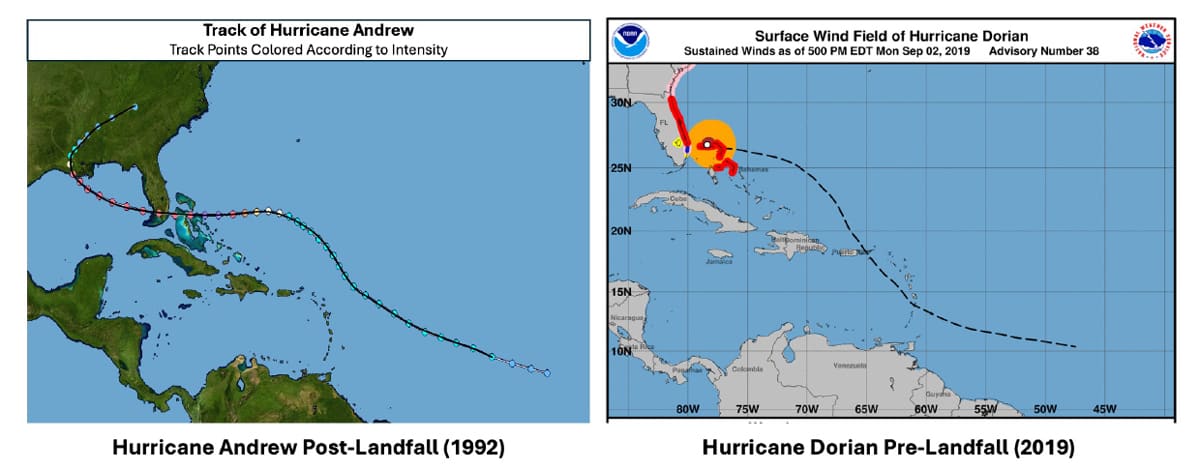
Figure 1 – Comparing the track of Hurricane Andrew (1992) and that of Hurricane Dorian (2019) when it was threatening the Miami-Dade region but had not yet made landfall.
What Does a Worst-Case Scenario Look Like?
One extreme scenario that comes out of hurricane research and can greatly benefit from counterfactual analysis (CFA) is the multiple landfalling hurricane.
In this context, we refer to a single event that makes landfall at least twice along the U.S. coastline at hurricane strength (≥ 74 mph). Such events can pack the punch of two or more hurricanes, cause widespread damage and loss across several highly exposed regions, and subject loss inflation (also called demand surge) and vast disruption to supply chains and commerce.
Events that make multiple landfalls and affect multiple zones of exposure are not overly rare. Over the past several decades, there are numerous examples with diverse characteristics (refer to Fig. 2, below).
Back in 1954, Hurricane Carol made two landfalls along the U.S. East Coast in locally less populated areas, producing a relatively modest economic loss of $5-10B in today’s dollars.
In 1992, an event that in many ways spawned the CAT modeling industry itself – Hurricane Andrew – made landfall in Miami-Dade County before re-emerging over the Gulf and making another landfall along the Louisiana coast a few days later. Andrew produced an inflation-adjusted economic loss of about $100B.
Hurricane Katrina took a similar path to Andrew; however, it was its second landfall near New Orleans that led to most of the aftermath to the industry, estimated to total over $300B in economic loss owing to its prolonged domino effect on multiple industry sectors.
Other storms, like Ian (2022), struck both the west coast of Florida and the Mid-Atlantic Coast, while storms like Ike (2008) and Helene (2024) made a single intense landfall that was followed by extreme inland losses well after landfall and well away from coastal exposure.
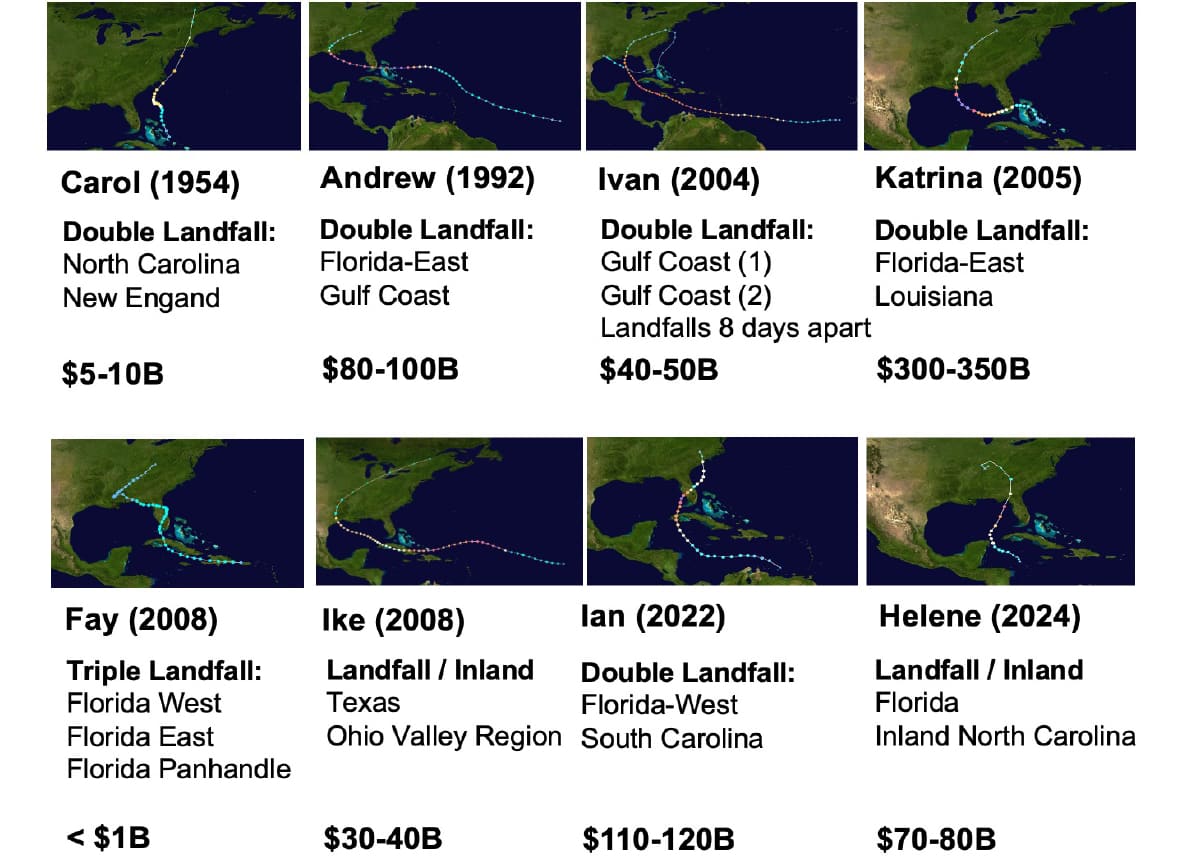
Figure 2 – Historical examples of tropical cyclones that produced large losses in multiple exposed regions. Loss values are based on publicly available estimates of total direct and indirect economic losses adjusted for inflation.
But none of these represent a worst-case scenario for several reasons.
First, each of these landfalls could have occurred with more intense winds. Katrina’s impact, for example, was dominated by storm surge and inland flooding owing to the breached levee system, while winds were observed at CAT3 intensity. Fifteen years later, Hurricane Laura affected the same region with much stronger CAT4 winds.
Second, each landfall could have occurred on a slightly different but more highly exposed path. A slight shift north in Hurricane Ian’s track would have focused the strongest winds on the Tampa-St. Pete region, which could have moved the dial considerably on both insured and economic loss.
Third, the simultaneous impact of all sources of loss – direct wind damage, storm surge, inland rainfall and indirect damage via business interruption, loss of power, supply chain disruptions, and unrelated movements in the macro economy – all could exacerbate losses attributed to the event itself.
Last, there is no physical reason why the worst-case of one event could not combine with the worst case from another. Is it possible that a single event could combine the worse of two landfalls, for example combining a CAT5 in Miami (the worst of Andrew) with a CAT5 in New Orleans (a stronger Katrina)? More broadly, how strong could each landfall in a multiple landfall scenario get, and how do we know such an event is even possible?
Figure 3 shows a case and point. In the early days of October 2025, a medium-range outlook for the tropical Atlantic showed the possibility of a hurricane forming in the Main Development Region (MDR) about two weeks later.
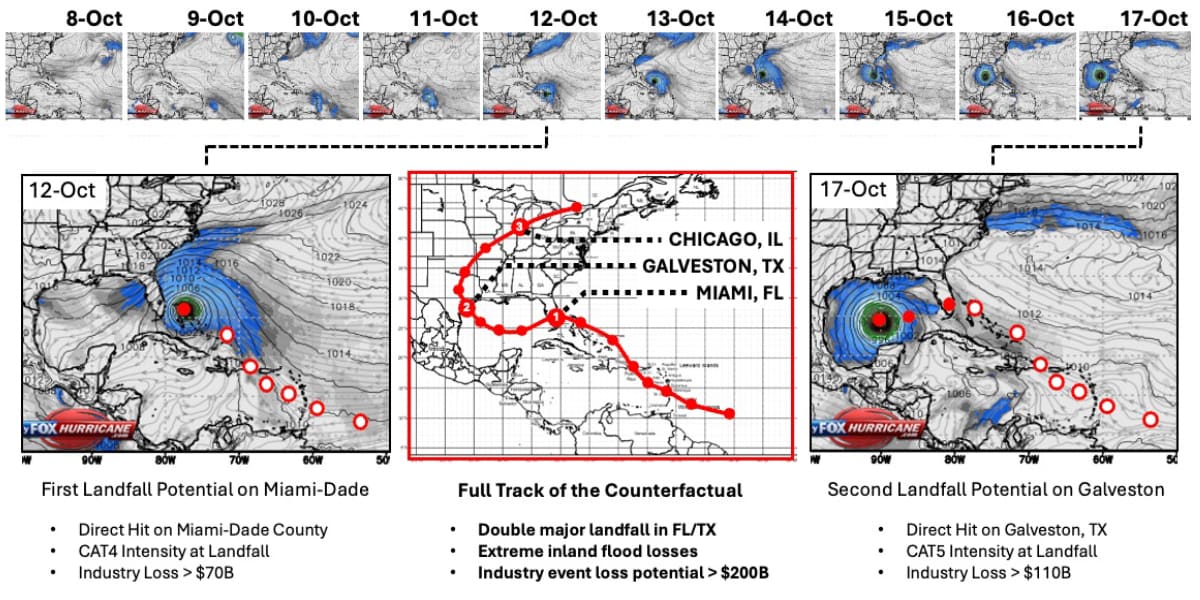
Figure 3 – Repurposing what may have been lost as a ‘poor forecast’ as a bonafide counterfactual scenario
This ‘simulated’ but plausible event was forecast to approach the east coast of Florida (lower left panel) at major hurricane strength, cross the peninsula and dissipate, then leverage record-breaking sea surface temperatures (SSTs) in the Gulf to intensify rapidly back to major hurricane status. This particular simulation ends with a major hurricane approaching the Texas coastline (lower right panel). One can envision — were this forecast to play out as simulated – that a second intense landfall could occur anywhere along the Texas or northern Gulf coast.
Just 6 hours later in the next cycle of updated forecasts, the same model simulated an entirely different hurricane – due to the sensitivity of these longer-range forecasts to slight changes in their initial conditions – this one missing the U.S. entirely. As in the case of Dorian, it would be easy to breathe a sigh of relief and move onto the next forecast. But, just as in Dorian, the fact that a worst-case outcome for an actual event does not occur is irrelevant to CFA.
In fact, we know that any one of these forecast threads are unlikely to play out exactly as modeled. But as this example emphasizes, the leverage we obtain from CFA is valuable despite uncertainties in the forecast. Had this scenario not been forecast as a potential future from actual conditions that occurred in the current climate, we may not have taken that ‘second look’ to identify its risk profile and ask if it’s properly represented in the CAT models. We might just brush it off as an unreliable two-week forecast and move on.
How Can We Learn from Counterfactual Analysis?
- Testing Realism: Using this simple example of multiple-landfall risk, we can evaluate forecast scenarios from actual historical conditions without the worry of creating ‘Frankenstein’ events that appear extreme but are not physically possible.
- Testing Frequency: Using realistic simulations of individual hurricanes affecting diverse regions such as the Gulf and Florida or the Southeast and Northeast, we can compare the frequency at which such compound events occur in stochastic model catalogs.
- Testing Intensity: All events are not created equal, thus the range of impacts from a double landfall in the Gulf will differ from an event like Ian with a second landfall in the Southeast or the highly-exposed Northeast corridor.
- Testing Correlation: When a single event affecting multiple regions contractually qualifies
as a single occurrence of loss, the implications can be profound, especially if the scenario is treated differently in the CAT model’s financial module. Ivan (2004), for example, made a second Gulf landfall over a week after its first one. Had this second landfall been at major hurricane strength, event definition could have become a sharp point of contention. - Testing Physics: One of the reasons the hypothetical event in Figure 3 stands out is its potential for two major hurricane landfalls, separated by its passage and dissipation over the Florida peninsula. From the atmospheric physics embedded in the model, we know why this is possible. First, the track weaves its way through the Caribbean islands without making landfall or dissipating. This facilitates the first landfall at major hurricane strength. Second, after dissipating over Florida, the simulated hurricane intensifies in record warm Gulf waters (as observed in 2025), returning to major hurricane strength and making another catastrophic landfall. Past storms like Katrina have intensified over similar Gulf conditions. The simulated event shown in Figure 3 could go on to cause widespread inland flooding, further exacerbating losses. We also know this is physically plausible, as we have witnessed in storms like Ike (2008) and Helene (2024) that left behind unprecedented flooding in regions not normally subject to hurricane risk.
- Testing Convergence: CAT models’ foundation is stochastic modeling, which is a statistical technique that produces very large catalogs of potential future events. One question for highly unusual tracks like this one is how well does the CAT model represent the risk? Does it contain enough events that look like this one – bringing two intense landfalls followed by severe inland flooding? This unique combination may only occur once in a million simulated hurricanes, so with a finite catalog of say one million outcomes, we would only expect one or two of them, maybe none. Using CFA combined with modern AI-based simulation tools (see Special Series on AI – Part 1: AI Models De-Mystified | Aeolus Capital Management), we can produce hundreds or even thousands of examples of unusual high-impact ‘gray swan’ scenarios to ensure they are properly accounted for in the CAT models, and if not, make adjustments accordingly.
Counterfactual Analysis: The Takeaway
CFA is equipped to expand on a foundational view of the catastrophic risk. It is one of many analytical tools used by Aeolus Research to create value via insights, sanity checks, and alternative views of risk.
As noted, CFA can also open the door to evaluating extreme scenarios that have multiple components never before considered in combination. The case of multiple U.S. hurricane landfalls from a single tropical cyclone is not only plausible, but such cases have been observed and studied. Like other analytical tools in CAT modeling, CFA is providing new perspectives on the most extreme risks in our ever-changing climate.
By combining CAT models, numerical forecast models, AI technology and the insights from CFA, Aeolus Research is deploying cutting-edge refinements to underwriting and portfolio construction in ways that target identifying and filling the gaps in risk.
DISCLAIMER
THE INFORMATION CONTAINED IN THIS REPORT (THIS “REPORT”) IS BEING FURNISHED BY AEOLUS CAPITAL MANAGEMENT LTD. (“AEOLUS”) FOR DISCUSSION PURPOSES ONLY AND MAY NOT BE USED FOR ANY OTHER PURPOSE. THIS REPORT MAY NOT BE COPIED, RECORDED OR REPRODUCED OR OTHERWISE PROVIDED TO THIRD PARTIES IN WHOLE OR IN PART WITHOUT AEOLUS’ PRIOR WRITTEN CONSENT.
THIS REPORT CONTAINS AEOLUS AND ITS AFFILIATES’ VIEWS ON VARIOUS UNCERTAIN SCIENTIFIC CONCEPTS AND CONTENT. RECIPIENTS AND THEIR ADVISORS SHOULD PERFORM THEIR OWN INDEPENDENT REVIEW WITH RESPECT TO SUCH MATTERS AND REACH THEIR OWN INDEPENDENT CONCLUSIONS.
WHILE EFFORT AND CARE HAS BEEN TAKEN IN PREPARING THE CONTENT OF THIS REPORT, AEOLUS AND THE AUTHORS DISCLAIM ALL WARRANTIES, EXPRESSED OR IMPLIED, AS TO THE ACCURACY OF THE INFORMATION SET OUT HEREIN. FURTHER, NEITHER AEOLUS NOR THE AUTHORS SHALL BE LIABLE FOR ANY LOSSES OR DAMAGES ARISING FROM THE USE OF, OR RELIANCE ON THE INFORMATION OR THE REFERENCES SET OUT HEREIN.
PORTIONS OF THIS REPORT HAVE BEEN OBTAINED FROM THIRD-PARTY SOURCES. WHILE SUCH INFORMATION IS BELIEVED TO BE RELIABLE BY AEOLUS AND THE AUTHORS, NO EXPRESS OR IMPLIED WARRANTY, REPRESENTATION OR GUARANTEE IS MADE AS TO THE CORRECTNESS, COMPLETENESS OR SUFFICIENCY OF SUCH THIRD-PARTY INFORMATION. WHERE A THIRD-PARTY RESOURCE HAS BEEN REFERENCED, AEOLUS SEEKS TO ACCURATELY CITE SUCH RESOURCE. NO CONTENT WITHIN THIS REPORT IS KNOWINGLY AN INFRINGEMENT OF COPYRIGHT. ANY POTENTIAL INFRINGEMENT CAN BE IMMEDIATELY ADDRESSED AND WHERE APPROPRIATE RECTIFIED, ON NOTIFICATION TO AEOLUS.
THIS REPORT CONTAINS THE CURRENT OPINIONS OF AEOLUS AND SUCH OPINIONS ARE SUBJECT TO CHANGE WITHOUT NOTICE. AEOLUS TAKES NO RESPONSIBILITY FOR UPDATING THE INFORMATION CONTAINED HEREIN AS FACTS OR AEOLUS’ VIEWS DEVELOP IN FUTURE. STATEMENTS IN THIS REPORT ARE MADE AS OF THE DATE OF THE INITIAL COMMUNICATION AND THERE SHALL BE NO IMPLICATION THAT THE INFORMATION HEREIN IS CORRECT AS OF ANY TIME SUBSEQUENT TO SUCH DATE.
THE INFORMATION CONTAINED IN THIS REPORT IS PROPRIETARY IN NATURE. BY YOUR ACCEPTANCE OF THIS REPORT, YOU AGREE NOT TO USE THIS REPORT IN ANY WAY DIRECTLY OR INDIRECTLY DETRIMENTAL TO AEOLUS.