


Understanding the Saharan Air Layer and Atlantic Hurricane Activity
Every summer in North America, property owners exposed to Atlantic hurricane risk brace for the coming season and what it may or may not have in store. Starting months earlier, seasonal hurricane forecasters examine key climate factors that influence tropical activity – such as sea surface temperatures and the El Niño / La Niña cycle –to project how much more or less active the upcoming season may be. Still, these forecasts are fraught with uncertainty, partly because these climate signals are themselves difficult to predict. Just as importantly, there are a number of “wildcards” or shorter-term and less predictable factors, that have the potential to surprise even the most experienced forecasters.
What is the Saharan Air Layer?
Some of these wildcard factors have been discussed in prior InSight articles. In this InSight, we examine the relationship of dust storms from the Sahara Desert to Atlantic activity. Scientists refer to the episodic intrusion of dry, dusty air from the Sahara as the “Saharan Air Layer” (“SAL”). The SAL can travel thousands of miles from the African continent and influence the formation and intensification of tropical cyclones (“TCs”), since the SAL dust storm “season” runs from late Spring to early Fall, overlapping with the first two-thirds of the Atlantic hurricane season.
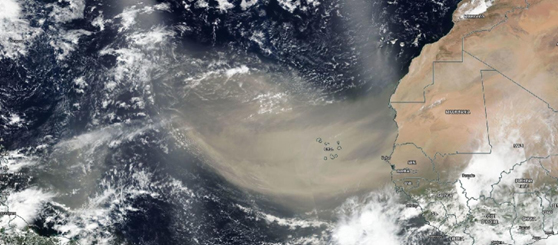
Figure 1 – Satellite image of an SAL event covering thousands of square miles over the tropical eastern Atlantic Ocean with dust and particulates originating from the African continent
These dust storms, from which the SAL got its name, typically form when an “easterly wave” tracks along the southern edge of the Sahara Desert and projects huge volumes of dust into the atmosphere. These waves – areas of low pressure that move from east to west across the tropics – often cause the development of thunderstorms along the Intertropical Convergence Zone (“ITCZ”). Tropical waves generally track westward and can lead to the formation of TCs in both the Atlantic and northeastern Pacific basins. This is why a season in which easterly waves align with the Sahara Desert is so important for stifling TC formation.
The Interaction of Macro and Microscales
Much of what has been discussed so far refers to “macro” effects, or atmosphere-ocean dynamics occurring at scales much larger than individual thunderstorms. In contrast, dust particles contained within the SAL, and their influence on TCs, relate to the field of microphysics, the dynamics of which occur at scales much smaller than a cloud. To understand how macro and micro effects interact in an SAL environment, one must consider the dynamics within a thunderstorm holistically.
The influence of dust within a thunderstorm is an active area of research. Intuitively, dust acts at the macroscale to dry out the atmosphere, which runs counter to the humid environment required for thunderstorms to develop. On the other hand, dust can introduce more “condensation nuclei” (“CN”) – kernels around which cloud droplets grow – such that the SAL acts to facilitate cloud development at the microscale. However, dust is not the optimal CN, rather in a normal dust-free atmosphere, thunderstorms efficiently use ice crystals to develop vigorous updrafts and intense winds. Since a TC is an organized complex of thunderstorms, one would conclude that, depending on the interaction of the macro and microscale, a SAL event could either facilitate or suppress TC development.
Figure 2 shows a schematic representation of thunderstorm dynamics interacting at both scales. In weak cloud systems (left), such as an easterly wave or forming depression, SAL dust and the heat it absorbs from the sun cause evaporation of ice crystals and keep cloud tops “warm”, well below the height they would achieve in a dust-free environment. As a result, dust becomes more concentrated in a more compact cloud, preventing vertical motions from reaching high into the freezing layer. This less efficient CN distribution inhibits development.
On the other end of the intensity spectrum (right), a deep mature complex of thunderstorm cells can deepen and expand due to the “invigoration effect”. The deep strong updraft (red arrows) transports moist air from the warm Atlantic surface, counteracting the evaporation that occurs in weaker systems. As a result, more ice crystals are available as CN. In addition, SAL dust particles transported into the freezing layer can themselves become more efficient as CN. This becomes a positive feedback cycle that can invigorate thunderstorm cells, lifting the cloud tops even higher, leading to a deeper freezing layer, more ice crystals and, in turn, even deeper and wider thunderstorms.
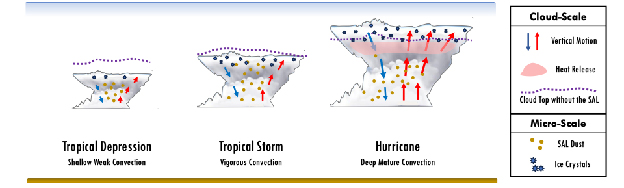
Figure 2 – Relationship of SAL dust to thunderstorm development at the macro and micro scales, showing net detrimental effects to development in weak TCs and a more supportive role in hurricanes having deep and mature convection. (Adapted from Luo and Han, 2021: Impacts of the Saharan air layer on the physical properties of the Atlantic tropical cyclone cloud systems.)
Because weaker TCs are more common than hurricanes in the eastern Atlantic, where SAL dust is most concentrated, the frequency of this positive effect in hurricanes is less common than the detrimental effects seen in weaker systems. So, in any given season, the net effect of SAL on TC development may be muted and difficult to quantify.
On a seasonal basis, dust that originates in the southwest Sahara stays relatively constant from year to year. However, dust from the northwestern Sahel region varies significantly from one hurricane season to the next, and understanding this inter-seasonal variability is a key to improving seasonal hurricane outlooks. An accurate forecast of the SAL in April for the upcoming months of August and September would need to predict the volume (or total mass) of dust that will be transported from the African continent, and more importantly, how far west into the Main Development Region (“MDR”) it will travel. Unfortunately, the combined effects of large-scale and local weather patterns observed during the actual season will ultimately determine the impact of the SAL on actual TC activity, making the net effect difficult to predict. Some studies have shown promise in relating SAL activity during the prior calendar year as the key factor in answering the “volume” question – namely, how much dust will get transported over the Atlantic during the subsequent hurricane season. But as with hurricanes themselves, accurately predicting the journey the SAL will take a season in advance is a much bigger hurdle.
More research is required before seasonal SAL prediction can add material value and make seasonal hurricane forecasts more actionable.
Direct Impacts on Atlantic Hurricane Development
The average SAL dust event typically expands over a 2-mile (3.2 km) thick vertical layer of the atmosphere, starting around a mile (1.6 km) above the surface. The consensus research has shown that the thermal stability and dryness associated with the SAL tends to suppress tropical cyclone formation and intensification. In addition, strong winds that propel the dry layer westward, often for hundreds or even thousands of miles, can generate anomalously high vertical wind shear (the change of wind speed with height), another impediment to TC formation.
Given all the factors that influence this complex process, why is dust so influential to hurricane risk? First, dusty air contains about half the moisture of the typical tropical atmosphere. That’s the difference between a balmy summer day in Miami, Florida versus one at the same temperature in Phoenix, Arizona. This air of very low relative humidity can quickly weaken a ‘seedling’ tropical disturbance by promoting a process known as ‘subsidence’, or the descent and stabilizing of the atmosphere around a fledgling storm.
Another “macro” factor associated with an active SAL cycle is the wind it generates – often topping 40 mph (18 m/s). This airflow, in an otherwise calm environment, causes increased wind shear in and around the TC’s structure and surrounding environment. And, because SAL-induced shear lies about 7,000 to 14,000 feet (2 to 4 km) above the surface, it can cause what is known as “vortex tilting” and be particularly harmful to the TC’s heat engine, which is most efficient when upright.
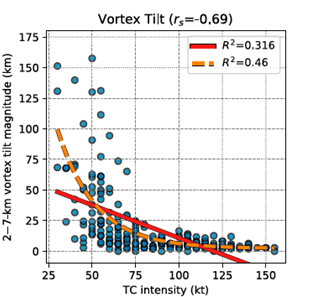
Figure 3 – Data from observed hurricanes shows an important negative correlation between a TC’s intensity and the degree of tilt in the spinning vortex. (Source: Fischer, et al, An analysis of tropical cyclone vortex and convective characteristics in relation to storm intensity using a Novel Airborne Doppler radar database. Monthly Weather Review, Sep 2022, pp. 2255-2278).
Understanding Cause and Effect
It is important to note that the warm air inherent to the SAL layer acts to stabilize the atmosphere, which occurs when the dust warmed by radiation at mid-levels sits atop cooler (dust-free) air below it, increasing mid-level stability and inhibiting rising motion. Because clouds develop in rising air, the SAL can directly inhibit the formation of convective clouds (i.e., thunderstorms) that derive energy from vertical motion.
Because the mineral dust can be suspended in the air for weeks at a time, the SAL’s sustained absorption of sunlight helps maintain its own warmth as it periodically builds up and crosses the tropical Atlantic. In fact, intense SAL episodes can temper Atlantic sea-surface temperatures (“SSTs”) by up to 1°C (1.8°F) in the crucial zones of development within the MDR, from the coast of Africa to the eastern Caribbean, thereby starving developing hurricanes of their primary fuel.
With a less optimal environment in which to form and develop, it’s quite rare to see prolific basin activity under the prolonged cover of a dusty atmosphere. Often, an active Saharan dust storm season is more of a symptom than a cause of quiet conditions in the Atlantic. As discussed, the dust itself does play an important role in tempering MDR activity, but several larger-scale (macro) atmospheric ingredients must coincide for that dust to concentrate, and more importantly travel sufficiently far across the Atlantic Ocean to have a material impact on the regions where TCs are most prevalent.
This is why the SAL season is so important to the climatology of hurricane risk. Not unlike the Southwest U.S. monsoon season which can make or break the regions’ August and September water resources, the SAL can make or break an Atlantic hurricane season during its climatological cycle, sometimes making its impact into late August or early September.
Some Takeaways
Just as with any other climate factor that has the potential to modulate hurricane activity, the Saharan Air Layer can be a positive or negative factor, or not a factor at all.
In many Atlantic seasons, the SAL and the dry air it propagates over the Atlantic is fairly benign, either because these dust-laden windstorms are spotty and weak, or because an active SAL season ends well before hurricane season really gets going. We pay very close attention to the region where the SAL has its most immediate impact – namely along the west coast of Africa – because many of the most destructive U.S. landfalling hurricanes have in fact originated there. Some of the most notorious include the Great Galveston Hurricane of 1915, the Great New England Hurricane of 1938 (the “Long Island Express”), Hurricanes Hugo (1989), Andrew (1992), Bertha (1996), Floyd (1999) and Irma (2017), to name a few. These powerful and impactful storms may not have come to such a catastrophic conclusion had they developed under different SAL conditions.
Beyond a single season, we are also interested in the SAL phenomenon and its influence on hurricanes in a changing climate, since anthropogenic warming is having varied effects on regional climate and local perils. Some research has suggested that recent expansion of the Sahara Desert’s footprint is due to anthropogenic warming, especially along the desert’s northern boundary. If that holds true, this could lead to more frequent SAL events, perhaps expanding farther to the north. Still, as discussed, the net effect of the SAL on storms of an individual season is a consequence of many competing factors, but this may be an emerging one.
Other climate model research is projecting that the future climate may actually increase atmospheric humidity and precipitation over the northern half of the African continent, making the Saharan region a moister, less dusty environment. However, long-term climate model projections such as this have low confidence and are nearly impossible to validate. And, as with the possibility of SAL events getting stronger, a weaker SAL may or may not lead to changes in TC activity.
Despite the scientific challenges and uncertainties, this branch of research is fundamental to our current understanding of hurricane cycles, both within a season and from one season to the next, and is one of many factors that the Aeolus team considers in its continuing pursuit to understand and estimate risk.
DISCLAIMER
THE INFORMATION CONTAINED IN THIS REPORT (THIS “REPORT”) IS BEING FURNISHED BY AEOLUS CAPITAL MANAGEMENT LTD. (“AEOLUS”) FOR DISCUSSION PURPOSES ONLY AND MAY NOT BE USED FOR ANY OTHER PURPOSE. THIS REPORT MAY NOT BE COPIED, RECORDED OR REPRODUCED OR OTHERWISE PROVIDED TO THIRD PARTIES IN WHOLE OR IN PART WITHOUT AEOLUS’ PRIOR WRITTEN CONSENT.
THIS REPORT CONTAINS AEOLUS AND ITS AFFILIATES’ VIEWS ON VARIOUS UNCERTAIN SCIENTIFIC CONCEPTS AND CONTENT. RECIPIENTS AND THEIR ADVISORS SHOULD PERFORM THEIR OWN INDEPENDENT REVIEW WITH RESPECT TO SUCH MATTERS AND REACH THEIR OWN INDEPENDENT CONCLUSIONS.
WHILE EFFORT AND CARE HAS BEEN TAKEN IN PREPARING THE CONTENT OF THIS REPORT, AEOLUS AND THE AUTHORS DISCLAIM ALL WARRANTIES, EXPRESSED OR IMPLIED, AS TO THE ACCURACY OF THE INFORMATION SET OUT HEREIN. FURTHER, NEITHER AEOLUS NOR THE AUTHORS SHALL BE LIABLE FOR ANY LOSSES OR DAMAGES ARISING FROM THE USE OF, OR RELIANCE ON THE INFORMATION OR THE REFERENCES SET OUT HEREIN.
PORTIONS OF THIS REPORT HAVE BEEN OBTAINED FROM THIRD-PARTY SOURCES. WHILE SUCH INFORMATION IS BELIEVED TO BE RELIABLE BY AEOLUS AND THE AUTHORS, NO EXPRESS OR IMPLIED WARRANTY, REPRESENTATION OR GUARANTEE IS MADE AS TO THE CORRECTNESS, COMPLETENESS OR SUFFICIENCY OF SUCH THIRD-PARTY INFORMATION. WHERE A THIRD-PARTY RESOURCE HAS BEEN REFERENCED, AEOLUS SEEKS TO ACCURATELY CITE SUCH RESOURCE. NO CONTENT WITHIN THIS REPORT IS KNOWINGLY AN INFRINGEMENT OF COPYRIGHT. ANY POTENTIAL INFRINGEMENT CAN BE IMMEDIATELY ADDRESSED AND WHERE APPROPRIATE RECTIFIED, ON NOTIFICATION TO AEOLUS.
THIS REPORT CONTAINS THE CURRENT OPINIONS OF AEOLUS AND SUCH OPINIONS ARE SUBJECT TO CHANGE WITHOUT NOTICE. AEOLUS TAKES NO RESPONSIBILITY FOR UPDATING THE INFORMATION CONTAINED HEREIN AS FACTS OR AEOLUS’ VIEWS DEVELOP IN FUTURE. STATEMENTS IN THIS REPORT ARE MADE AS OF THE DATE OF THE INITIAL COMMUNICATION AND THERE SHALL BE NO IMPLICATION THAT THE INFORMATION HEREIN IS CORRECT AS OF ANY TIME SUBSEQUENT TO SUCH DATE.
THE INFORMATION CONTAINED IN THIS REPORT IS PROPRIETARY IN NATURE. BY YOUR ACCEPTANCE OF THIS REPORT, YOU AGREE NOT TO USE THIS REPORT IN ANY WAY DIRECTLY OR INDIRECTLY DETRIMENTAL TO AEOLUS.