

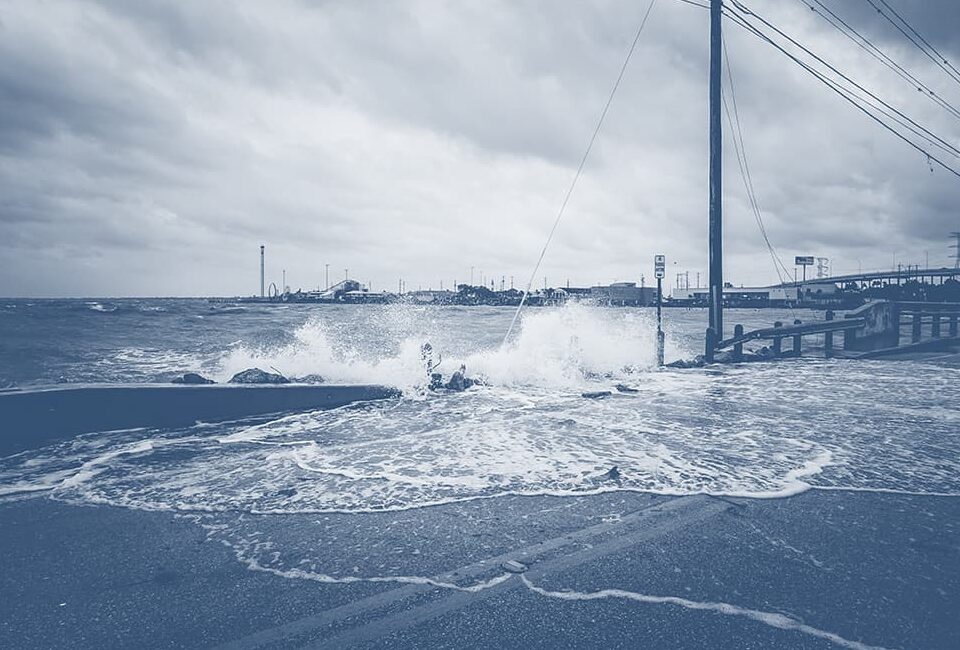
Overview of the key drivers of damage and insured loss in winter season extratropical cyclones (“winter storms”).
Applicability ■■■■
Background
Extratropical cyclones (“ETCs”) – also called “mid-latitude cyclones” or “winter storms” – are centers of low pressure that generally form between 30º and 60º latitude in both hemispheres. Unlike tropical cyclones (“TCs”), ETCs can develop year-round and are typically most intense during the winter season. While TCs gain strength from the heat of the ocean surface, ETCs are energized by temperature contrast between cold polar air and warm equatorial air, along a band of strong upper-level winds that mark that contrast, known as the jet stream. Hence, ETCs tend to be strongest in the winter season when that contrast is at its greatest. On average, over 1,500 ETCs form in each hemisphere annually, and several are typically present on any given day of the year.
Some of the most notable ETCs have produced a potent mix of wind, precipitation and freezing temperatures that, when passing over land, have resulted in widespread damage. Sustained winds over land in the “Great Storm of 1703”, for example, are estimated to have reached 110mph, which on the Saffir-Simpson wind scale is equivalent to that of a CAT2 hurricane. More often, ETCs pack more moderate winds, but, when combined with snow, ice and brutally cold temperatures, they can rival their hurricane counterparts in terms of damage and insured loss. For example, in 1993, the “Storm of the Century” brought damage and widespread disruption to the Eastern U.S. and still ranks high in the list of most damaging storms in the Northeast and Ohio Valley regions.
Objective
In this InSight, we examine the three main drivers of damage and insured loss in ETCs; namely, wind, frozen precipitation, and cold temperatures.
Wind
In areas of an ETC where pressure deepens quickly, the strongest winds are observed. This most often occurs near the center of low pressure and within elongated zones of low pressure known as ‘troughs’ which extend out from the center as cold and warm fronts. As a result, the damaging wind field in an ETC can extend hundreds of miles from the center.
Wind-borne property damage is often initiated at the roofline where uplift pressure peels tiles and causes structural compromise. ETCs rarely produce winds strong enough to lift the entire roof, except in cases of poor or highly vulnerable construction. Winds can also subject structures to shear and lateral loads, which in turn, can compromise structural integrity. However, substantial damage resulting from ETC winds (rarely > 100mph) is uncommon.
Catastrophe models are able to capture the full spectrum of ETC winds, provide a full inventory of buildings that can potentially be damaged, and, subsequently, estimate the wind loss potential for ETCs affecting the U.S. and Europe.
Precipitation
Precipitation in ETCs can be quite diverse – a mix of rain, snow, frozen rain and sleet – and in some cases even large hail. As in TCs, rain can lead to flooding. ETCs, however, add frozen precipitation to the equation, which imparts weight or ‘gravity loads’ that last as long as the precipitation remains frozen – often weeks or even months after the storm has passed. This means ETCs leave behind conditions that can accumulate with subsequent storms. For example, a series of five 2-ft. snowstorms can pose similar risks as a single ETC leaving 10-ft. of snow depth.
Ice and frozen rain can be particularly problematic because of their weight. Ice can adhere to power lines and tree branches causing prolonged outages and exacerbated property damage. As with wind, heavy snow and ice can cause a roof to fail when the weight exceeds the design load of support beams. A flat or low pitch roof is most vulnerable to heavy snow loads.
Catastrophe models are able to quantify the damage potential of both ice and snow as well as special circumstances such as increased vulnerability of drifting snow common to certain roof designs.
Cold Temperatures
ETCs global function is to equilibrate the imbalance between polar (cold) and equatorial (warm) air. As a result, U.S. and European winter storms transport cold air south and warm air north. Often they leave behind bitterly cold temperatures in regions not accustom to this risk, especially when factoring in the coupled hazards of wind and frozen precipitation.
Cold temperatures can cause direct physical damage to property through a process known as ‘ice damming’ in which repeated melting and refreezing of snow can expand decking over the roof eaves and compromise the roof structure. Often the problem is made worse near a poorly insulated attic where warm air inside the home escapes or by melting periods between the passage of multiple ETCs.
Catastrophe models are able to capture the vulnerabilities caused by extreme cold and simulate temperature variability over the course of the winter season to estimate the un-melted snow pack left behind after one or more winter storms.
Key Findings
- The U.S. and Europe are both exposed to the risks of extra-tropical cyclones or ETCs. ETCs are most intense in the middle of the winter season when the contrast between cold polar air and warm equatorial air is at its maximum.
- ETCs are very frequent, when compared to their tropical cyclone counterparts. At any given time, several ETCs are moving along a band of high-altitude winds known as the jet stream. ETCs are made up of a center of low pressure with cold and warm fronts extending out from the center. The most severe weather is located near the center and along the frontal zones.
- Wind is a common sub-peril in ETCs. Winds can cause material property damage, especially to roofs, where uplift loads can lead to a compromise in structural integrity. Total roof loss is uncommon in ETCs since the winds are typically well within design loads.
- Heavy precipitation, especially in frozen form, can cause heavy weight or ‘gravity’ loads, which in some extreme cases, can lead to roof collapse. Most often, we observe frozen precipitation causing downed tree limbs and power lines, both of which can potentially contribute to elevated damage and disruption, especially in regions not accustomed to such conditions.
- Cold temperatures are the third key sub-peril in ETCs. By themselves, cold temperatures can damage structural components when moisture melting and refreezing occurs over time. Cold air also increases the likelihood that frozen precipitation left by one ETC will combine with a later snow storm and increase the associated risks.
Implications for Aeolus
Catastrophe models simulate a full spectrum of ETC intensity and geography across both the U.S. and Europe. While ETCs occur year-round, the most intense, and those containing the full mix of sub-perils, occur in the midst of the winter season. Aeolus actively employs winter storm models which are able to make robust estimates of the hazards and building vulnerabilities associated with these severe storms. These models explicitly capture the potential for loss owing to strong winds, heavy rain, frozen precipitation and outbreaks of extremely cold temperatures. In addition, the models are able to account for the seasonal accumulation of risk that results from a series of winter storms, without significant melting in between. Due to the high frequency of occurrence of ETCs noted above, Aeolus also incorporates recent observed loss history (called experience rating) during risk analysis to capture specific regional and counterparty trends for this peril. Of course, Aeolus follows the latest scientific and modeling developments in the area of extreme ETC events.
DISCLAIMER
THE INFORMATION CONTAINED IN THIS PAPER (THE “INFORMATION”) IS BEING FURNISHED TO RECIPIENTS ON A CONFIDENTIAL BASIS BY AEOLUS CAPITAL MANAGEMENT LTD. (“AEOLUS”) FOR DISCUSSION PURPOSES ONLY AND MAY NOT BE USED FOR ANY OTHER PURPOSE. THIS INFORMATION MAY NOT BE COPIED, RECORDED OR REPRODUCED OR OTHERWISE PROVIDED TO THIRD PARTIES IN WHOLE OR IN PART WITHOUT AEOLUS’ PRIOR WRITTEN CONSENT.
THIS PAPER CONTAINS INFORMATION REGARDING AEOLUS AND ITS AFFILIATES’ VIEWS ON VARIOUS UNCERTAIN SCIENTIFIC CONCEPTS AND CONTENT. RECIPIENTS AND THEIR ADVISORS SHOULD PERFORM THEIR OWN INDEPENDENT REVIEW WITH RESPECT TO SUCH MATTERS AND REACH THEIR OWN INDEPENDENT CONCLUSIONS.
WHILE EFFORT AND CARE HAS BEEN TAKEN IN PREPARING THE CONTENT OF THIS PAPER, AEOLUS AND THE AUTHORS DISCLAIM ALL WARRANTIES, EXPRESSED OR IMPLIED, AS TO THE ACCURACY OF THE INFORMATION SET OUT HEREIN. FURTHER, NEITHER AEOLUS NOR THE AUTHORS SHALL BE LIABLE FOR ANY LOSSES OR DAMAGES ARISING FROM THE USE OF, OR RELIANCE ON THE INFORMATION OR THE REFERENCES SET OUT HEREIN.
PORTIONS OF THE INFORMATION HAVE BEEN OBTAINED FROM THIRD PARTY SOURCES. WHILE SUCH INFORMATION IS BELIEVED TO BE RELIABLE BY AEOLUS AND THE AUTHORS, NO EXPRESS OR IMPLIED WARRANTY, REPRESENTATION OR GUARANTEE IS MADE AS TO THE CORRECTNESS, COMPLETENESS OR SUFFICIENCY OF SUCH THIRD PARTY INFORMATION. WHERE A THIRD PARTY RESOURCE HAS BEEN REFERENCED, AEOLUS SEEKS TO ACCURATELY CITE SUCH RESOURCE. NO CONTENT WITHIN THIS PAPER IS KNOWINGLY AN INFRINGEMENT OF COPYRIGHT. ANY POTENTIAL INFRINGEMENT CAN BE IMMEDIATELY ADDRESSED AND WHERE APPROPRIATE RECTIFIED, ON NOTIFICATION TO AEOLUS.
THIS PAPER CONTAINS THE CURRENT OPINIONS OF AEOLUS AND SUCH OPINIONS ARE SUBJECT TO CHANGE WITHOUT NOTICE. AEOLUS TAKES NO RESPONSIBILITY FOR UPDATING THE INFORMATION CONTAINED HEREIN AS FACTS OR AEOLUS’ VIEWS DEVELOP IN FUTURE. STATEMENTS IN THIS PAPER ARE MADE AS OF THE DATE OF THE INITIAL COMMUNICATION AND THERE SHALL BE NO IMPLICATION THAT THE INFORMATION IS CORRECT AS OF ANY TIME SUBSEQUENT TO SUCH DATE.
THE INFORMATION CONTAINED IN THIS PAPER IS NON-PUBLIC, CONFIDENTIAL AND PROPRIETARY IN NATURE. BY YOUR ACCEPTANCE OF THIS PAPER, YOU AGREE TO TREAT THE CONTENTS AS CONFIDENTIAL AND NOT TO USE IT IN ANY WAY DIRECTLY OR INDIRECTLY DETRIMENTAL TO AEOLUS.