

The El Niño Southern Oscillation (“ENSO”), describes quasi-periodic swings in sea surface temperatures (“SSTs”) that have been observed as long as weather has been recorded. ENSO is a feature of ‘internal climate variability’, meaning it occurs naturally in the global environment. The nature of the ENSO cycle does not appear to have been materially altered by the increases in global SSTs associated with anthropogenic (human-induced) climate change.
Figure 1 shows the relevant temperature data recorded since the 1980s, with the upper time-series displaying a clear upward trend in global SSTs; the lower time series shows the ENSO cycle as a comparison to the long-term average. In contrast to the global temperature measurements, ENSO is a regional phenomenon of warming (El Niño) and cooling (La Niña) of the eastern tropical Pacific. To enable consistent measurement of the magnitude of the ENSO anomaly, the scientific community has assigned a series of geographically defined “boxes” in the Pacific Ocean as their regions of reference.

Figure 1 – El Niño and La Niña – the warm and cool states of ENSO respectively – are measured by +/- 0.5ºC deviations from average SSTs in the tropical Pacific, most often defined in the Nino-3.4 box shown in red (left). While global surface temperatures have been on the rise, ENSO appears to operate independently of these global trends (above). Neutral periods defined by deviations of less than 0.5ºC are interspersed in the tie series (white). El Nino (red) and La Nina (blue) periods tend to recur roughly every 3 to 7 years.
The Niño-3.4 “box” (inset map shown in red) has become the standard for most scientific studies, particularly those associated with the teleconnection with the Atlantic Ocean – more on this later.
In the term ENSO, the first half EN (El Niño) captures the oceanic part of the oscillation, in which the waters of the tropical Pacific warm to over 0.5C above the long-term average. The second half SO (Southern Oscillation) captures the atmospheric part of the cycle, in which trade winds, and the broader Walker Circulation1 that they influence, weaken as a result of the oceanic response, making the coupling of the ocean and atmosphere intrinsic to the ENSO phenomenon. The effects of ENSO are carried by the atmospheric response globally and can influence the weather worldwide. These relationships of ENSO to its effects on the weather in other parts of the world are known as ‘teleconnections’.
ENSO and the Atlantic teleconnection
One of the most important ENSO teleconnections is tied to its influence on vertical wind shear2 in the Atlantic Ocean. The connection occurs via the Walker Circulation which connects atmospheric conditions in the tropical Pacific to conditions in the west tropical Atlantic and the Gulf of Mexico. During Atlantic hurricane season every June through November, this connection can influence both the frequency and severity of Atlantic hurricanes, since the magnitude of wind shear is a critical factor in hurricane development. The ENSO cycle and its effects are shown in Figure 2.

Figure 2 – El Niño and La Niña are teleconnected to the Atlantic through their effect on the permanent climate feature known as the Walker Circulation. For example, in El Niño, the warm cycle of ENSO (top), a warm pool sets up in the Eastern Pacific due to weakened trade winds. This in turn affects the Walker Circulation – an east-to-west oriented circuit situated globally over the tropics – moving the most concentrated convection and precipitation to the U.S. West Coast and the tropical Atlantic. This disrupts weather conditions where hurricanes form, causing a marked increase in upper-level winds and an associated increase in wind shear. The counterpart cycle in La Niña, which has the net effect of reduced Atlantic shear, is shown in the bottom panel.
What exactly triggers the start of an ENSO warm or cool event is not fully understood, though it’s clear the two components – the oceanic temperature component and the atmospheric circulation component – are strongly related. It’s likely that an ENSO event is self-limiting; that is during an El Niño event, the weakening of easterly trade winds slows a process known as “upwelling” in which cold waters from the deep ocean rise to the surface. Less upwelling allows warm surface waters to build in the eastern Pacific, but this process cannot continue indefinitely. The warming of the sea surface works to decrease atmospheric pressure above it, thereby inducing a pressure imbalance that increases the strength of the trade winds and begins to reverse the process that began with weakened trades.
Assessing and understanding the impact of the ENSO cycle on Atlantic hurricanes
The regulating effect of this negative climate feedback is the reason that all El Niño and La Niña events will eventually subside. It also explains why much of the observed ENSO cycle is in the ‘neutral’ state, in which SSTs are within +/-0.5C of the long-term average. Despite the wide body of ENSO research that began in the 1960s3, precisely measuring the effect on Atlantic hurricanes remains a challenge.
One key aspect related to Atlantic hurricanes is the transition between the neutral state and an El Niño (warm) or La Niña (cool) state – known as the ‘onset phase’. The timing and duration of this transition period has been shown to influence the strength of the Atlantic teleconnection. One of the physical reasons for this ‘lag effect’ is that the ocean responds more slowly to change than the atmosphere due to its relatively high thermal capacity. Water can retain 4x as much heat as the air, and in turn responds much more slowly to external changes in temperature4.
As a result, the effects of ENSO on the atmosphere and the ocean develop at different rates, creating a gap in their relative response times. From the observed data, scientists estimate the influence of the ENSO decay phase – the dissipation of El Niño or La Niña – on the following hurricane season is much less than the onset phase 5.
Another challenge to understanding ENSO’s effects on hurricanes is the complex regional relationship of ENSO to Atlantic wind shear conditions. During a La Niña event, for example, while Atlantic wind shear is reduced allowing more favorable conditions for hurricane development, the location and duration of that reduced shear is non-uniform and unpredictable. On any given day, areas of low shear may or may not coincide with the location of a hurricane, making the tangible effects inconsequential and therefore difficult to quantify .
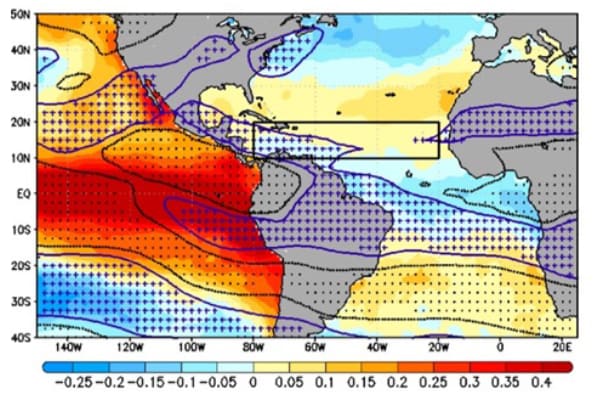
However, from a large-scale and long-term climatic perspective, the influence of ENSO on Atlantic wind-shear has been the subject of significant scientific study. One study that quantified the effect on shear looked at the size of the shear anomaly across the full Atlantic basin. Figure 3 shows the effect graphically, with the blue stippled region across the southern Gulf of Mexico and the western sector of the MDR showing the highest sensitivity to El Niño conditions6.
Source: Atmosphere 2016, 7(7), 87
Figure 3 – The ENSO wind shear teleconnection is not experienced uniformly across the entire Atlantic. The primary region of influence (denoted by the highlighted blue + signs) is most apparent in the southern Gulf of Mexico and western tropical Atlantic. Notably, these areas are critical entry points for tropical cyclones that go on to impact the Gulf of Mexico and Florida coastlines.
This pocket of higher or lower wind shear during hurricane season can have an impact on the outcomes of any individual hurricane season since many storms that go on to make landfall in the U.S. pass through this zone on their development journey. It is however worth noting that predicting the precise location and intensity of the wind shear in these zones is very challenging even within the Atlantic hurricane season itself.
Some key takeaways
ENSO operates in the Pacific Ocean as an important feature of natural climate variability, moving through anomalously warm and cool states known as El Niño and La Niña, respectively. In general, it takes between 3 and 7 years for an ENSO state to complete a full cycle, with many seasons remaining in a neutral state having no clear warm or cool anomaly. As the ENSO cycle evolves, it can have a tangible influence on vertical wind shear in the Atlantic Ocean. During the Atlantic hurricane season, this influence can have a bearing on hurricane activity.
The relationship of ENSO to wind shear is complex as its tied to both long time scales in the ocean and much shorter time scales in the atmosphere. These contrasting effects cause a lag between an ENSO event in the Pacific and wind shear effects in the Atlantic. Furthermore, some studies have shown that the onset of ENSO is more profound than its dissipation. Finally, and perhaps most importantly, there is no way to predict exactly where ENSO will affect Atlantic wind shear conditions, although climatology positions the highest sensitivity in the southern Gulf and western tropical Atlantic. Because these areas are rich in ocean heat and moisture, they can play an important part in the overall number and intensity of Atlantic hurricanes that go on to make landfall and ultimately produce loss.
Research into the life cycle of ENSO and its influence on global weather continue. Climate modelers seek to understand how ENSO evolves and what triggers the end to El Niño and the start of La Niña. Weather modelers focus on the regional effects of ENSO and wind shear effects on individual hurricanes. As our scientific understanding deepens, and observations establish the significance of these diverse relationships, the ability to forecast ENSO and its effects on Atlantic hurricanes will further improve.
Footnotes
1 The Walker Circulation is a conceptual model of atmospheric flow in the tropics in the lower atmosphere. According to this model, parcels of air follow a closed circulation in the zonal and vertical directions. This circulation, which is roughly consistent with observations, is caused by differences in heat distribution between large regions of ocean and land.
2 Vertical wind shear, or wind gradient, refers to differences in wind speed at different altitudes. High levels of wind shear tend to impede tropical cyclone formation.
3 Cry, G.W. Effects of Tropical Cyclone Rainfall on the Distribution of Precipitation Over the Eastern and Southern United States; Professional Paper 1; United States Department of Commerce, Environmental Sciences Services Administration: Washington, DC, USA, 1967; p. 67.
4 The concept of heat capacity is illustrated by observing water temperatures in an outdoor pool. While typical summer air temperatures may vary from below 60 degrees at night to above 90 degrees in the afternoon, the temperature of the pool may only warm and cool by a few degrees each day. This is due to the water’s enormous heat capacity – which greatly limits its exchange of heat with the air.
5 Bove, M.C.; Elsner, J.B.; Landsea, C.W.; Niu, X.; O’Brien, J.J. Effect of El Niño on U.S. landfalling hurricanes, revisited. Bull. Am. Meteorol. Soc. 1998, 79, 2477–2482.
6 Rodríguez-Fonseca, B., Suárez-Moreno, R., Ayarzagüena, B., López-Parages, J., Gómara, I., Villamayor, J., Mohino, E., Losada, T., and Castaño-Tierno, A.: A review of ENSO influence on the North Atlantic. A non-stationary signal, Atmosphere, 2016, 7, 1–19.
References
Cry, G.W. Effects of Tropical Cyclone Rainfall on the Distribution of Precipitation Over the Eastern and Southern United States; Professional Paper 1; United States Department of Commerce, Environmental Sciences Services Administration: Washington, DC, USA, 1967; p. 67.
Bove, M.C.; Elsner, J.B.; Landsea, C.W.; Niu, X.; O’Brien, J.J. Effect of El Niño on U.S. landfalling hurricanes, revisited. Bull. Am. Meteorol. Soc. 1998, 79, 2477–2482.
Rodríguez-Fonseca, B., Suárez-Moreno, R., Ayarzagüena, B., López-Parages, J., Gómara, I., Villamayor, J., Mohino, E., Losada, T., and Castaño-Tierno, A.: A review of ENSO influence on the North Atlantic. A non-stationary signal, Atmosphere, 2016, 7, 1–19.
DISCLAIMER
THE THE INFORMATION CONTAINED IN THIS PAPER (THE “INFORMATION”) IS BEING FURNISHED TO RECIPIENTS ON A CONFIDENTIAL BASIS BY AEOLUS CAPITAL MANAGEMENT LTD. (“AEOLUS”) FOR DISCUSSION PURPOSES ONLY AND MAY NOT BE USED FOR ANY OTHER PURPOSE. THIS INFORMATION MAY NOT BE COPIED, RECORDED OR REPRODUCED OR OTHERWISE PROVIDED TO THIRD PARTIES IN WHOLE OR IN PART WITHOUT AEOLUS’ PRIOR WRITTEN CONSENT.
THIS PAPER CONTAINS INFORMATION REGARDING AEOLUS AND ITS AFFILIATES’ VIEWS ON VARIOUS UNCERTAIN SCIENTIFIC CONCEPTS AND CONTENT. RECIPIENTS AND THEIR ADVISORS SHOULD PERFORM THEIR OWN INDEPENDENT REVIEW WITH RESPECT TO SUCH MATTERS AND REACH THEIR OWN INDEPENDENT CONCLUSIONS.
WHILE EFFORT AND CARE HAS BEEN TAKEN IN PREPARING THE CONTENT OF THIS PAPER, AEOLUS AND THE AUTHORS DISCLAIM ALL WARRANTIES, EXPRESSED OR IMPLIED, AS TO THE ACCURACY OF THE INFORMATION SET OUT HEREIN. FURTHER, NEITHER AEOLUS NOR THE AUTHORS SHALL BE LIABLE FOR ANY LOSSES OR DAMAGES ARISING FROM THE USE OF, OR RELIANCE ON THE INFORMATION OR THE REFERENCES SET OUT HEREIN.
PORTIONS OF THE INFORMATION HAVE BEEN OBTAINED FROM THIRD PARTY SOURCES. WHILE SUCH INFORMATION IS BELIEVED TO BE RELIABLE BY AEOLUS AND THE AUTHORS, NO EXPRESS OR IMPLIED WARRANTY, REPRESENTATION OR GUARANTEE IS MADE AS TO THE CORRECTNESS, COMPLETENESS OR SUFFICIENCY OF SUCH THIRD PARTY INFORMATION. WHERE A THIRD PARTY RESOURCE HAS BEEN REFERENCED, AEOLUS SEEKS TO ACCURATELY CITE SUCH RESOURCE. NO CONTENT WITHIN THIS PAPER IS KNOWINGLY AN INFRINGEMENT OF COPYRIGHT. ANY POTENTIAL INFRINGEMENT CAN BE IMMEDIATELY ADDRESSED AND WHERE APPROPRIATE RECTIFIED, ON NOTIFICATION TO AEOLUS.
THIS PAPER CONTAINS THE CURRENT OPINIONS OF AEOLUS AND SUCH OPINIONS ARE SUBJECT TO CHANGE WITHOUT NOTICE. AEOLUS TAKES NO RESPONSIBILITY FOR UPDATING THE INFORMATION CONTAINED HEREIN AS FACTS OR AEOLUS’ VIEWS DEVELOP IN FUTURE. STATEMENTS IN THIS PAPER ARE MADE AS OF THE DATE OF THE INITIAL COMMUNICATION AND THERE SHALL BE NO IMPLICATION THAT THE INFORMATION IS CORRECT AS OF ANY TIME SUBSEQUENT TO SUCH DATE.
THE INFORMATION CONTAINED IN THIS PAPER IS NON-PUBLIC, CONFIDENTIAL AND PROPRIETARY IN NATURE. BY YOUR ACCEPTANCE OF THIS PAPER, YOU AGREE TO TREAT THE CONTENTS AS CONFIDENTIAL AND NOT TO USE IT IN ANY WAY DIRECTLY OR INDIRECTLY DETRIMENTAL TO AEOLUS.